
How Long Does it Take to Run a 5k? + How to Prepare
If you’re wondering, “How long does it take to run a 5k?” you’ve landed in the right place.
As someone who’s run many 5ks, I know that the time it will take you to complete a 5k depends on many things.
For example, I’ve run every type of 5k, from the annual Turkey trot to the popular Color Run 5k. My times at these two events are nowhere close to one another.
But the type of race isn’t the only thing you need to consider. Let’s discuss the important things you’ll need to know to understand how long it will take to run a 5k.
How Far is a 5k?
Before jumping into time, it’s important to understand how far a 5k is.
A 5k, or 3.1 miles, is one of the most popular distances in the running world. It’s easily achievable and can be completed by all levels of runners—from beginners to experienced marathoners.
5k in Kilometers
A 5k is equal to 5 kilometers (km).
The kilometer (also spelled kilometre) is a measurement within the International System of Units. People all around the world use the kilometer to measure distance.
That is people all around the world outside the US.
5k in Miles
In the US, people use miles to measure distance.
So if you’re in the U.S., like me, a 5k is equal to 3.1 miles. This can be really helpful when you’re training for a race and want to track your progress in miles instead of kilometers.
One kilometer equals .621 miles. When you multiply that number by 5, you get 3.1. This means 5 kilometers equals 3.1 miles.

How Long Does it Take to Run a 5k?
There isn’t a one-size-fits-all answer to how long it takes to run a 5k.
Many factors contribute to how long it will take you. Your speed, terrain, elevation, and fitness level affect your time.
If you’re an experienced runner with a good fitness base, running a 5k in 20 minutes or less is possible. Many beginner runners take around 40 minutes or more to run a 5k.
The average time to run one mile is 8 to 12 minutes, so we can predict running 3.1 miles will take around 24 to 36 minutes. However, running 3 miles requires three times as much effort as compared to running one mile.
Average 5k Running Pace by Gender
Data supplied by RunRepeat shows the average running pace for men and women.
The average men’s 5k run pace is 7 minutes and 4 seconds per kilometer. This equates to 11 minutes and 22 seconds per mile.
The average women’s 5k run pace is 8 minutes and 18 seconds per kilometer. This equates to 13 minutes and 21 seconds per mile.
Average 5k Finish Time by Age and Gender
Average finish times for any distance race vary by both age and gender.
➞ Men have faster finish times than women for every running distance.
➞ Younger runners tend to have faster finish times than older runners.
The average finish time for a beginner runner in the 20-year-old age group is 31:29. In contrast, someone within the 40-year-old age group is looking at an average time of 33:09.
Another way to look at average 5k finish times is on running ability. The following chart shows the average finish times for beginner runners.
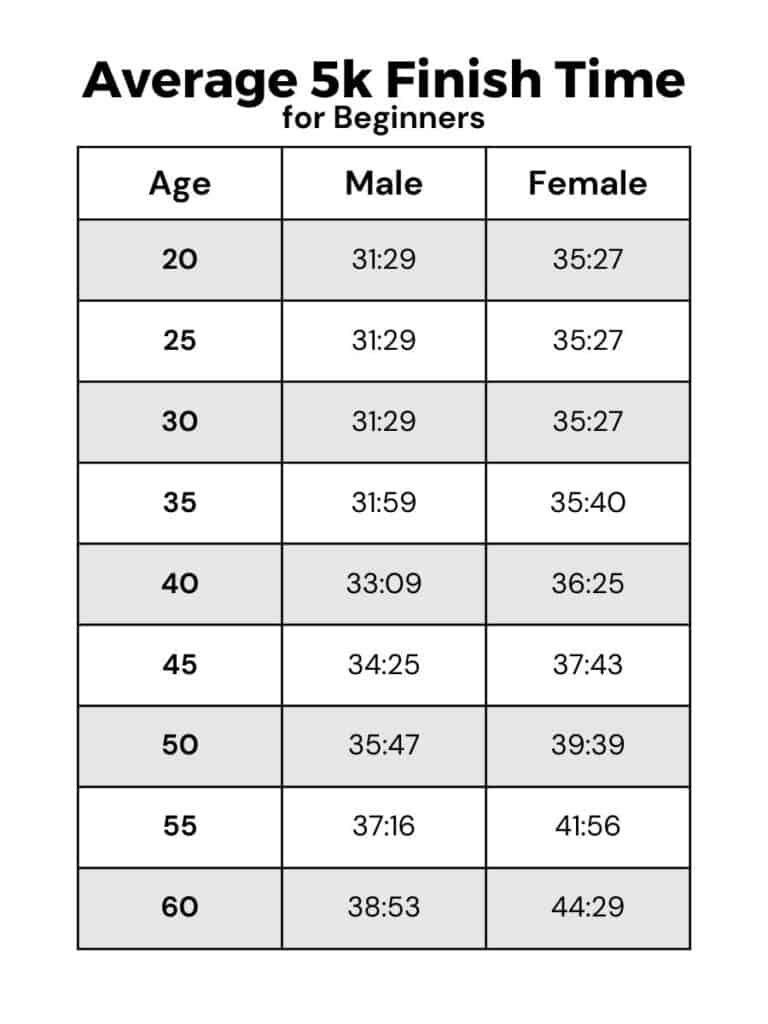
As you can see, beginner men consistently run faster than beginner women. Likewise, younger beginner runners have faster finish times than older beginner runners.
The following chart shows the same breakdown of age and gender but is based on intermediate running ability.

Factors that Impact How Fast A Person Runs a 5k
There is no one answer to the question, “How long does it take to run a 5k?”
In fact, the same person can run this distance several times and experience wildly different running times.
Why? Because numerous factors affect a runner’s pace. The following five elements can alter your finish time for a 5k.
👉🏼 Runner experience level
Although some runners are naturally fast, many have to work hard to hit a speedy pace.
Advanced runners spend time honing in on their pace. If you’re a beginner runner, you may not be able to run a 5k as quickly as someone who’s been running for a decade.
👉🏼 Fitness level
It’s easier to run when you’re in shape.
If your fitness level is fairly low, adjust your running expectations. Know that it’s unlikely to achieve fast speeds. Once you work hard to get in shape, you’ll find running faster becomes feasible.
👉🏼 Running Terrain
A flat route will reduce the time it takes to run a 5k compared to a hilly route.
Running on a surface like pavement will also make your 5k finish time quicker than running on a sandy beach.
👉🏼 Weather and Temperature Conditions
The weather has an impact on running speed, too.
Running in humid or windy conditions requires more effort from your body. So in less-than-ideal conditions, adapt your effort and expectations to meet the current weather.
👉🏼 Elevation changes in the route
Elevation changes can drastically affect running time. Depending on the course you run your 5k, your finish time can vary greatly from a previous time.
If you’re running uphill, a faster pace may not be possible. Similarly, take advantage of the downhill sections and go as fast as your body safely allows.
Ultimately, how long it will take you to complete a 5k depends on your skill level and the race course
5k Training Plan for Beginners
Looking for a 5k training plan?
5k training plans are vast. If you’re already an active runner, a four-week training plan will be plenty for you. If you’ve never run a day in your life, you’ll likely need at least eight weeks to train.
This specific plan will help take you from inactive to 5k finisher within ten weeks. You may have heard of the “couch-to-5k” training. This training schedule will help you go from stagnant couch potato to runner by race day.

Best Tips for Successful 5k Training
Training for a 5k is a great opportunity to get fit and become a runner.
To maximize the benefits of your training, follow these top tips.
✅ Include Strength Training
Strength training is important regardless of the distance you choose to run.
Strength training helps to build a strong foundation, prevent injuries, and help you achieve a faster running pace.
✅ Stay Consistent
It’s important to stay consistent in your running routine.
You’ll get better results if you run regularly and follow your training schedules (running and strength training!). Consistency helps to build endurance, which is key for a good 5k finish time!
✅ Start Slow & Increase Mileage Gradually
Don’t increase your mileage too quickly or go all out on your first few runs.
Start slowly and gradually increase the mileage as you become more comfortable running. This will prevent injuries and keep you motivated to continue running.
You can even choose to walk the 5k on race day if needed. If your body isn’t ready to run the distance, take the pressure off.
✅ Utilize Interval Training
The 5k is the shortest of all the long-distance races.
You must hold a quick pace for the full 3.1 miles to race it and win. For serious runners, the 5k is raced at a maintainable sprint.
Including interval training in your 5k training cycle is a great way to become faster. If you’re not a regular short-distance runner, you’ll definitely want to use intervals in your training.
✅ Set Realistic Goals
Having realistic goals is important when it comes to completing a 5k.
Don’t pressure yourself to hit a certain time goal if you’re just starting. Instead, focus on consistent running and improving your speed gradually.
Soon enough, you’ll be able to hit a specific time goal.

9 Best Health Benefits of Running a 5k
Running a 5k brings many physical and mental health benefits.
This activity requires minimal equipment and can be done by virtually anyone. Whether you’re a beginner looking to get into running or a seasoned pro, running a 5k can have lasting effects on your overall well-being.
These are the top benefits you’ll experience when deciding to run a 5k.
1. Improved cardiovascular health
Studies show that running is a great way to improve your cardiovascular health.
Better cardiovascular health means avoiding heart disease.
2. Strengthened bones and muscles
Running strengthens bones and muscles. Using your body weight as resistance is an effective way to build strength.
3. Increased energy levels
It’s no secret that running gives you energy.
As you run, your body releases endorphins, which are hormones that make you feel energized and happy.
4. Improved mental health
Running can help reduce stress and anxiety levels.
It increases blood flow to the brain and helps improve clarity, focus, and concentration.
5. Reduced risk of some chronic diseases
Running can help reduce the risk of developing chronic diseases like cancer and diabetes.
6. Greater endurance and stamina
Running can help build your endurance and stamina.
It’ll make it easier for you to do other activities that require a lot of energy, like playing your favorite sport or hiking.
7. Weight loss or maintenance
Running is an excellent way to shed excess weight. This is because of the amount of calories burned each time you run.
If you want to lose or maintain your current weight, training for and running a 5k can help you do that.
8. Improved sleep quality
Running can help you get better sleep.
Exercising during the day will tire out your body and make it easier to fall asleep at night. It also helps regulate your body’s natural circadian rhythm, so you wake up feeling refreshed in the morning.
9. Increased self-confidence and sense of accomplishment
Running a 5k is no easy task. When you cross the finish line, you’ll have a sense of accomplishment that will boost your self-confidence.
It’s the perfect way to challenge yourself and measure your progress.
FAQ
If you’re out of shape or a beginner runner, your 5k finish time will be closer to 45 minutes or more. The average walking pace for a mile is 15-22 minutes. If you can run at a 15 minutes per mile pace, you’ll finish a 5k in just over 45 minutes.
You need to build your fitness before attempting a 5k race. Follow a training plan for beginner runners to build strength and endurance over several weeks or months.
How long it takes to run a 5k depends on the runner. Experienced runners with good fitness can run a 5k in 20 minutes or less, while beginner runners may take up to 40 minutes or more. The time it takes also depends on the type of race, terrain, and weather condition.
Running a 5k on a treadmill takes around 25-30 minutes for most runners. Treadmill running can be more convenient since you don’t have to worry about the weather or terrain. But the time it takes you to complete a 5k on a treadmill will depend on your fitness level and speed.
On the treadmill, you have the bonus of the belt moving below you. While running on the treadmill can still be challenging, the moving belt makes it easier than running outside.
It depends on your current fitness level and how much effort you put in. If you’re starting from square one, it can take 6-12 weeks to get into shape for a 5k. Follow a training plan for beginner runners and give yourself plenty of time before attempting the 5k distance.
By putting in consistent effort, eating healthy, and getting plenty of rest, you’ll be able to reach your 5k goals in no time.
Final Thoughts: How Long Does it Take to Run a 5k?
The time it takes to run a 5k depends on many factors, such as speed, fitness level, terrain, and weather conditions. Experienced runners with good fitness can finish a 5k in 20 minutes or less, while beginner runners may take upwards of 40 minutes.