
How Many Miles is a 5k? 7 Tips for Success + a 5k Training Plan
I can still remember when I asked, “How many miles is a 5k?” This is a common question for new runners.
If you’ve never completed a 5k, why is it information that you’d need to know?
But now, perhaps it’s the first milestone on your running journey. So you’re going to need that answer – stat.
The distance of a 5k is 3.1 miles.
The good news is it’s a reasonable distance race, and it’s not too far. It’s also rare to find a shorter race distance.
I’ve run so many 5ks—some for fun, some for speed, and some as part of my training for longer races. So, let’s get to it so you can get on with your training!
How Many Miles is a 5k?
Understanding how far a 5k is is the first hurdle to getting you started on your journey.
A 5k is equal to 3.1 miles.
The “k” represents kilometers, a distance measurement many people use worldwide. If you continue to run distance races, you’ll find other lengths in kilometers, such as the 10k.

Is a 5k a Marathon?
It’s common to hear someone refer to a 5k as a marathon.
However, no, a 5k is not a marathon.
A marathon is a name for a specific distance race that equals 26.2 miles (or 42.2 kilometers). A half marathon is also a specific distance race that is exactly half the distance of a marathon (13.1 miles or 21.1 kilometers).
Non-runners will often refer to any running race as a marathon. I’ll occasionally kindly correct them, but more often, I’ll answer whatever question they’ve asked me about my distance race.
Is Running a 5k a Big Deal?
We’ve distinguished the difference between a 5k and a marathon, so is running a 5k even a big deal?
Absolutely!
Although a 5k is significantly shorter than a marathon, it is still an incredible accomplishment. Many long-term runners find their passion by signing up and running their first 5k race. This could be the same experience for you.
5k races also come with impressive elements. If you’re a fast runner, racing a 5k is quite an exhilarating experience. The world record 5k finishers for men and women ran their races in under 15 minutes!
The men’s 5k record holder is Joshua Cheptegei, with a finish time of 12:35:36.
The women’s 5k record holder is Lestesenbet Gidey, with a finish time of 14:06:62.
They’re both lightning-fast and show how thrilling the 5k race can be. Even if you’re not on the path to breaking the world record, you can still feel a sense of accomplishment when you complete your 5k.
How Long Should It Take to Run a 5k?
How long it should take to run a 5k will depend on a few details.
It’s important to remember that every runner is different. A person who can run a 5k in 20 minutes covers the same distance as a runner who finishes in 45 minutes. Both runners have accomplished the 5k.
A runner’s speed (also called pace) depends on things like age, gender, physical fitness, and level of training.
What’s the Average Time for a 5k?
When finding the average time for a 5k, we determine the result by assessing two categories:
👉🏼 The age of the runner.
👉🏼 The gender of the runner.
Male runners generally have faster times than female runners. This doesn’t mean that all men run faster than women. However, the first-place overall winner at most races is often a man.
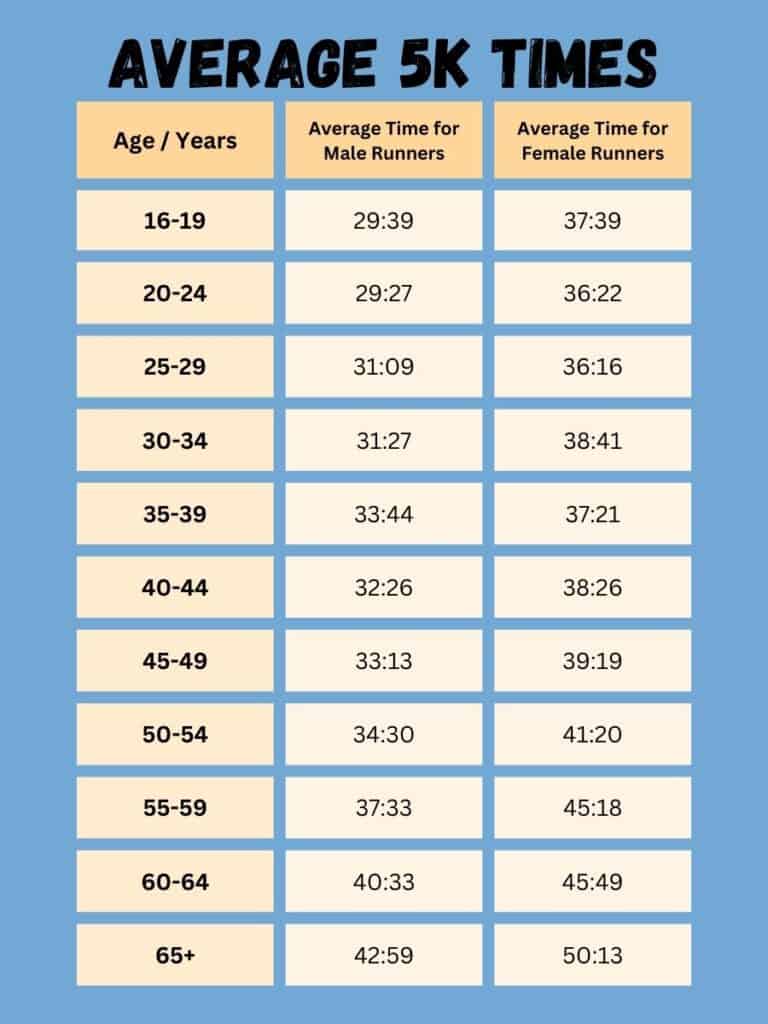
The following chart shows the average times for 5ks based on gender and age.
What’s a Good 5k Time for a Beginner?
If you’ve never run a 5k before, you might wonder what a good finish time is for a beginner.
Every runner is different; some want to hit a big goal during their first 5k. However, just completing your first 5k is a big running milestone accomplishment.
Looking at the above Average 5k Times chart, we see that, on average, men run a 5k with a time of around 30-40 minutes. Women, on average, tend to run a 5k with a time of around 35-45 minutes.
Consider the speed at which you can run a single mile. If you can run a mile in about 10 minutes, then a 30-minute 5k race goal might suit you.
If you can commit to some serious training, you might be able to increase your running pace and surprise yourself.
A Good 5k Time By Age
It’s always a good idea to consider the average time for a 5k for your age group.
Although it’s not a perfect representation due to some people running very quickly and others opting to walk the 5k, this still gives you a solid starting goal. It’s also important because age plays a big factor in our fitness and body’s ability.
A Good 5k Time By Gender
Again, based on the average results, gender plays a role in how quickly someone can run a 5k.
It’s good to be realistic when setting running goals, and although you might be able to run with the men going into your first 5k race, knowing that men generally run faster can help you plan your goal better.
Is Running a 5k in 25 Minutes a Good Time?
If you run a 5k in 25 minutes, you’ll need to keep a pace of 8 minutes and 3 seconds.
This is certainly possible for many runners, but whether it’s possible for you depends on your fitness level and training.
Is 25 minutes a good time for a 5k? Yes. Look back at the Average 5k Times chart, and you’ll see that 25 minutes beats all of the averages for male and female runners of all ages.
How Long Does it Take to Train to Run a 5k?
Now that you know for certain that you want to run your first 5k, your next question might be how long it takes to train for a 5k.
Good question!
To be properly trained for a 5k, you first need to assess the fitness level you’re at currently.
You can find numerous training plans on the internet called “Couch to 5k.” These 5k training plans intend to get a runner who isn’t very active to the point where they can complete a 5k.
These plans tend to be anywhere from 6 to 12 weeks.
If your physical fitness is above inactive, you can likely train for a successful 5k race in less than six weeks. Remember to check with your doctor to be sure that training and running a 5k is appropriate for you.
How Long Would it Take to Walk a 5k?
On average, a person can walk a mile in 15 to 22 minutes.
We can use this knowledge to figure out some basic math for how long it would take to walk a 5k.

This infographic shows us that, provided a person can walk an average mile in 15 to 22 minutes, they can walk a 5k in about 46 minutes to an hour and eight minutes.
Is it OK to Walk During a 5k Race?
Whether you’ve got your sights set on walking a 5k or approaching race day realizing you’re not quite ready to run, opting to walk a 5k is 100% acceptable.
There are so many great options for 5ks around the US. Many of these 5ks are “fun runs,” and most people participating will walk or use the run/walk method.
How To Successfully Train for a 5k
The best way to be prepared for your first 5k race is to lock in an excellent training plan.
I always recommend finding a running coach you can trust to guide you to the finish line. However, running should be accessible for anyone who wants to be a part of it; don’t be held back for lack of a coach!
The internet is an abyss of training plans. Perhaps that’s how you landed on my page today.
If you’re a beginner looking to train and run your first 5k race, you may find the following printable 5k training plan useful.

Some things to keep in mind:
👉🏼 Always get approval from your physician before starting a new fitness routine. It’s just best practice to be sure you’re healthy and that it’s safe to run.
👉🏼 If you’re not working with a coach, you’ll need to listen to your body. Just because a training plan tells you to run a certain number of miles doesn’t mean it’s written in stone. Adjust your plans if you must.
👉🏼 I’ve included days of run/walk intervals in this beginner’s 5k training plan. This means you might walk for a minute and run for three minutes. This is a big area where you can adjust to meet your needs.
👉🏼 Have fun. Don’t stress about running if you’re not looking to become an elite runner. I do this sport because I truly find it enjoyable. If you need motivation, consider using positive self-talk mantras to improve your experience.
7 Tips for Running a 5k
You’ve signed up for the 5k and have your training plan picked out. Now what?
To succeed on race day, I’ve compiled the seven fundamental tips for running your 5k race. Remember these during your training and by race day, and you’ll be well prepared.
✅ Commit to your training.
Whether you’re active or not, you should be sure to get the proper training. Although a 5k is a shorter distance race, it still requires effort. Training properly will help you have confidence on race day.
✅ Choose a race that makes you excited.
There are several serious 5ks if that’s what you’re looking to run. However, if you’d prefer, you can look for a “fun run” style 5k. Some of these races don’t keep official time, so keep this in mind when you choose your goal race.
✅ Figure out your routine.
When race morning rolls around, you should understand your needs well. What pre-race fuel works best for you? Do you find a particular warm-up to be helpful? What’s best for you to wear for this 5k?
Knowing what to eat before a 5k, what to wear, and the answers to these little questions will add enormous success.
✅ Choose a good running shoe.
Running shoes are the foundation of your running. If you wear shoes that are too small or don’t compliment your running style, your race might suffer.
Be sure to find the perfect pair of running shoes and break them in so they don’t give you blisters on race day.
✅ Situate yourself in the start line corral in an appropriate place.
If you know that your pace will be quick, consider finding a spot near the front of the start line corral. This means that you’ll be running alongside other fast runners.
If you feel you’ll be running at a slower pace, it’s best to start further back so you don’t get caught up running faster than you ultimately want.
✅ Try running negative splits.
This means you’ll run each mile slightly faster than the previous. If you start and run mile one at a 9-minute 33-second pace, maybe you run the second mile at a 9-minute 23-second pace.
Training for and running negative splits in your 5k means avoiding going out too fast and finding running the rest of the race difficult.
✅ Aim to run the tangents.
If you’ve never heard this, running the tangents means sticking to the shortest route for any race distance. You do this by finding the most direct way to cover the course by finding the inside of the turns.
Because a 5k is a shorter race, covering the shortest distance is key for landing a PR and taking even a few seconds off your race time.
Final Thoughts: How to Run a Successful 5k
If you’ve decided that a 5k is the distance race for you, congratulations! This means you can start your running journey with a great goal to keep you motivated. Who knows, a 5k could be your perfect distance race.